Collaborative Study by MERI Members Published in PNAS
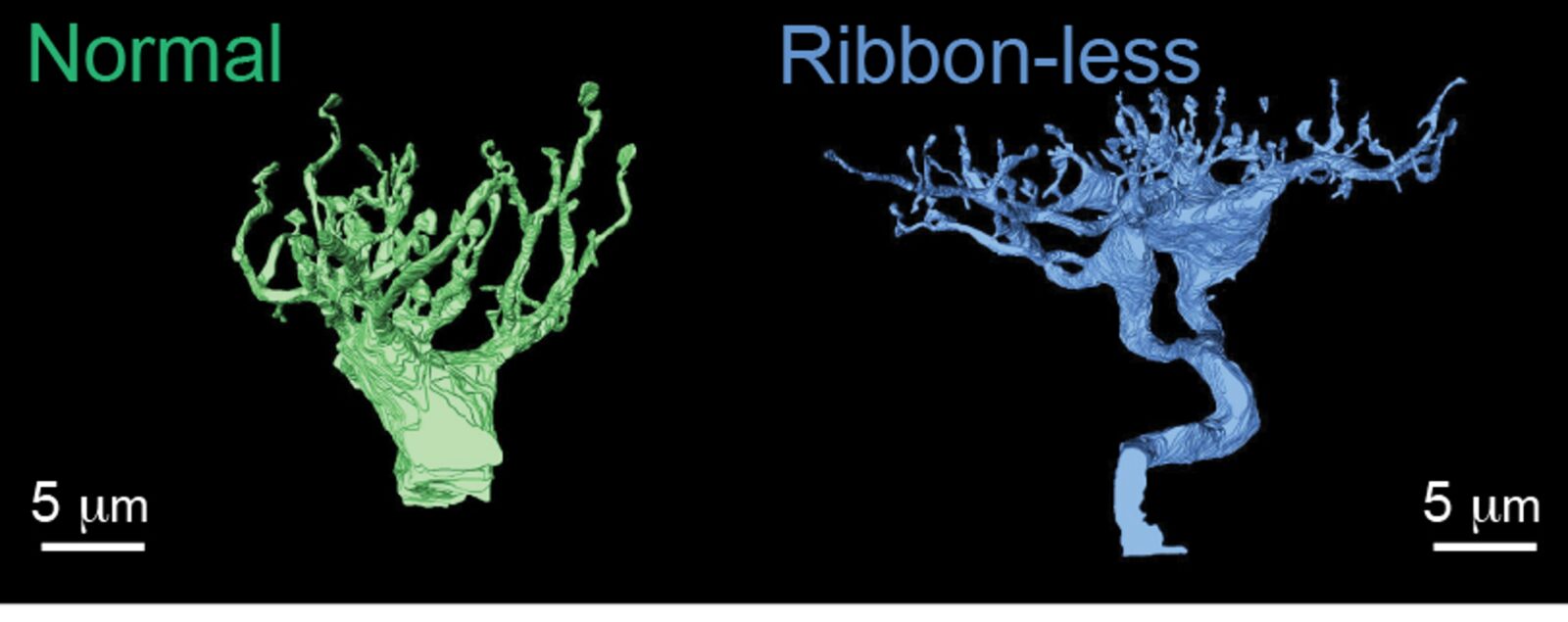
What are ‘ribbons’ doing in your eye?! A recent study by Sinha and Hoon labs uncovers new role(s) of these molecular components that fuel retinal visual processing.
Every time we see, the retina must rapidly transform patterns of light into signals that the brain can understand. This process depends on specialized connections between nerve cells called synapses. A recent study by Schultz et al., published in PNAS, focuses on the role of tiny structures within these connections called synaptic ‘ribbons’. For decades, ribbons were thought mainly to help retinal neurons continuously release chemical signals, neurotransmitters, in response to light. Schultz et al. reveal that ribbons play a much broader role. Using advanced microscopy and electrophysiological recordings, this study uncovered that ribbons help build and organize retinal circuits, ensuring that neurons form the appropriate connections. Findings from this study further reveal that ribbons help the retina perform essential visual computations, including detecting changes in light and dark, patterns, textures, and edges, while rapidly adapting to changing lighting conditions. Together, these findings reveal that synaptic ribbons are not simple molecular components of communication between retinal neurons; they act as architects and regulators of the visual system. Understanding these mechanisms may ultimately help guide efforts to restore vision following retinal disease or injury and inform the development of improved retinal prosthetics and stem cell-based therapies. Read the full article here.