New molecular therapy restores vision in model of inherited childhood blindness — and may open the door to treatment for dozens of rare diseases
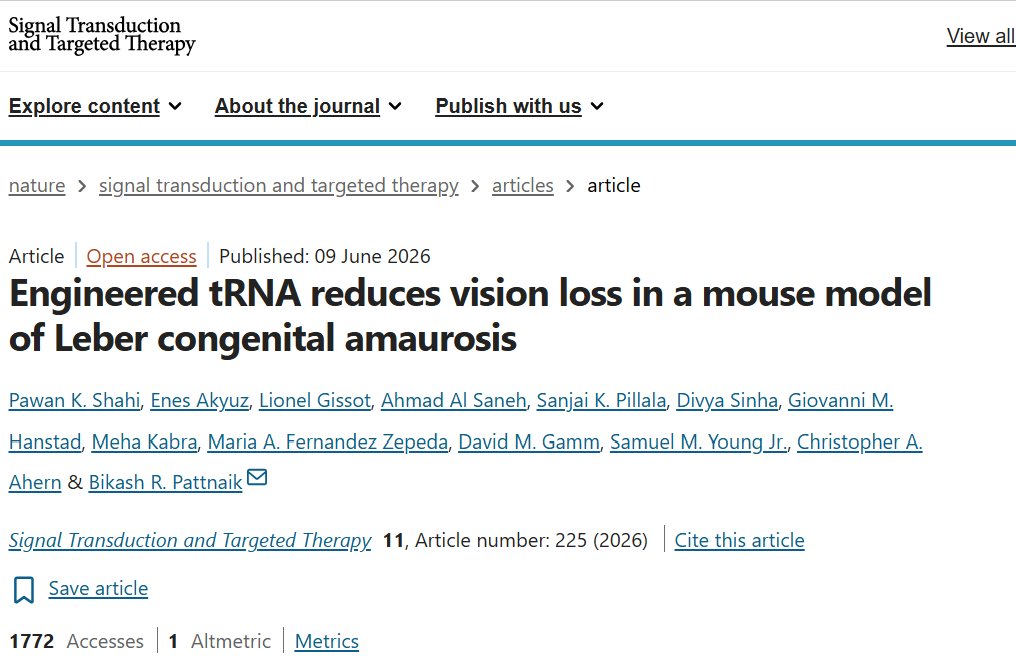
A University of Wisconsin–Madison team led by MERI RRF Daniel M. Albert Chair, Prof. Bikash Pattnaik, has developed a molecular therapy that restores vision in a mouse model of Leber congenital amaurosis type 16 (LCA16), a rare inherited childhood blindness with no currently approved treatment.
How it works: Rather than editing DNA, the therapy uses an engineered transfer RNA (called ACE-tRNA) to override a “nonsense mutation” — a premature stop signal in the gene KCNJ13 that prevents cells from building a functional protein (Kir7.1) essential for retinal health. Delivered via a modified virus, the engineered molecule reads past the error and produces the complete protein.
Results: In patient-derived stem cells, it restored Kir7.1 to 40% of normal levels (a 24-fold increase). In mice, a single injection produced sustained retinal recovery over 14 weeks with no toxicity.
Why it matters beyond LCA16: Nonsense mutations cause an estimated 15–20% of all inherited disorders, including cystic fibrosis and Duchenne muscular dystrophy, affecting over 3 million Americans. The researchers envision ACE-tRNA as a platform therapy — one approach adaptable across many diseases sharing this same class of genetic error. This is especially meaningful for ultra-rare conditions too small to attract commercial drug development.
The study was accepted in Signal Transduction and Targeted Therapy and was conducted in collaboration with the Universities of Iowa and North Carolina. The McPherson ERI is proud to have been among the supporters for this groundbreaking work through its RRF M.D. Matthews Professorship, Sandra Lemke Trout Chair in Eye Research, RRF Daniel M. Albert Chair in Eye Research, and RRF Emmett A. Humble Distinguished Directorship.
Read the full article here.